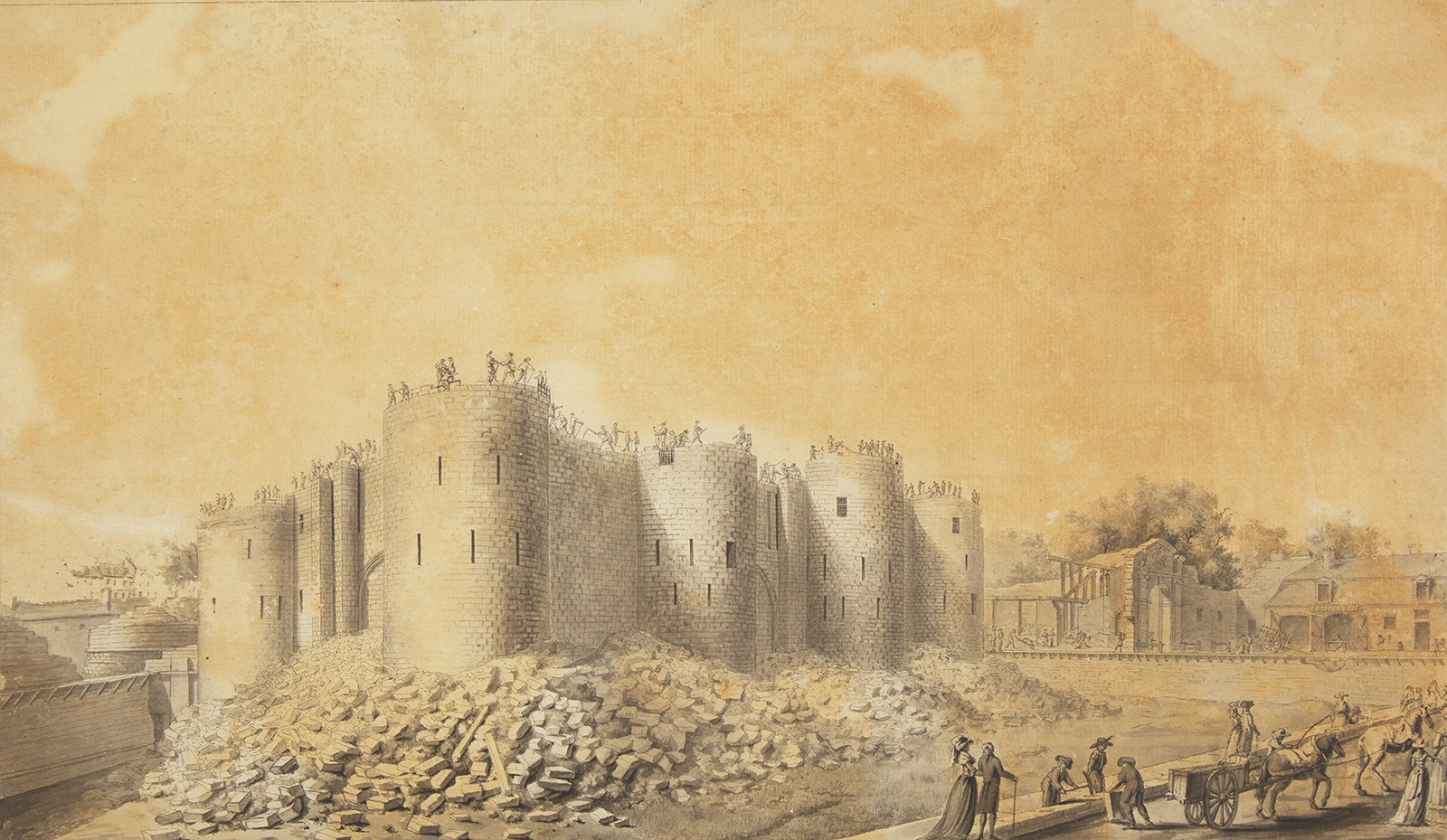
An extraordinary drawing marking the historic friendship between George Washington and the Marquis de Lafayette, as well as the correlation between the American and French Revolutions, will be on display in August at the Museum of the American Revolution for what might be one of its last public appearances. The artifact is set to go to auction in Philadelphia on Sept. 10.
The ink and wash drawing, titled The Destruction of the Bastille, depicts the demolished Bastille prison in Paris, France, on Aug. 8, 1789, just a few weeks after the July 14 uprising that ignited the French Revolution. On March 17, 1790, Lafayette wrote to Washington to inform him of the Revolution’s unfolding events, and gifted his former general and mentor this drawing along with the main key to the prison. At that time, Lafayette was at the height of his power as the head of the Paris National Guard, an appointment largely bestowed on him due to his military experience and succuss garnered while fighting in the American Revolutionary War.
“Give me leave, My dear General, to present you With a picture of the Bastille just as it looked a few days after I Had ordered its demolition, with the Main Kea of that fortress of despotism—it is a tribute Which I owe as A Son to My Adoptive father, as an aid de Camp to My General, as a Missionary of liberty to its patriarch,” Lafayette wrote.
The drawing was made by Étienne-Louis-Denis Cathala, one of the Bastille demolition site’s six inspectors, and became one of Washington’s most cherished possessions, having hung prominently in his presidential house as well as at his home, Mount Vernon. The key was donated to the Mount Vernon Ladies Association by John A Washington III, the last of the Washington family to reside at Mount Vernon, when he sold the property to the association in 1858. However, the family retained ownership of the sketch until 1891. It was then sold at auction and passed down through private collections, including at one point being owned by William Randolph Hearst. The original artifact has rarely been exhibited to the public in its over 200-year history, but recently appeared in Paris, France at Didier Aaron & Cie and will also be displayed briefly in New York and Chicago before being sold at auction.
“The Museum of the American Revolution relishes the opportunity to showcase this extraordinary piece of history to the public before its ownership changes and its fate becomes unknown,” said Dr. R. Scott Stephenson, President and CEO of the Museum of the American Revolution. “I can think of no better way to celebrate the impending 200th anniversary of Lafayette’s 1824-25 tour of America than to bear witness to this great historical reminder of reverence, camaraderie, and courage.”
“We are very excited for this artifact to be displayed at the Museum, only four blocks from where it once hung in Washington’s Philadelphia home, and only blocks away from where Freeman’s first set up shop only 15 years later, in 1805,” said Darren Winston, Senior Vice President and co-head of the Books & Manuscripts department for Freeman’s | Hindman.
The Destruction of the Bastille will be offered as a part of Freeman’s | Hindman’s Books and Manuscripts auction on Sept. 10 in Philadelphia. For more information, please visit freemansauction.com.

 Philadelphia RowHome Magazine's Blog